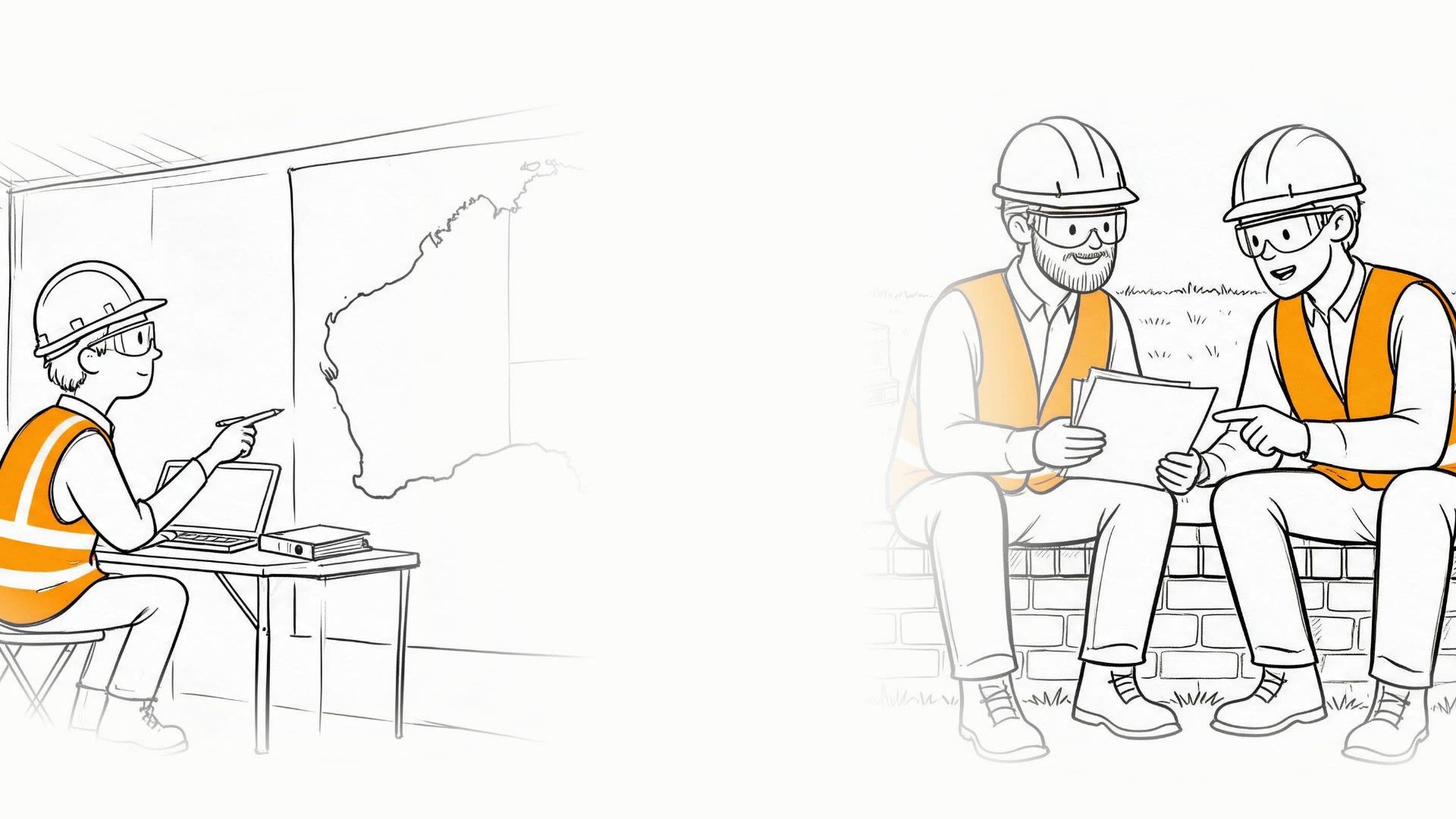
In Victoria, an employer or self-employed person must not perform high risk construction work (HRCW) unless a Safe Work Method Statement (SWMS) is prepared before the work starts and the work is done in line with it (regulation 327 of the Occupational Health and Safety Regulations 2017). The SWMS must be reviewed when the work changes or the controls are not working, and a copy kept for the duration of the work. The regulations do not require signatures.
Victoria is the one state that did not adopt the national model Work Health and Safety (WHS) laws, so the Act, the terms and some of the rules are different. This page covers the Victorian rules. To compare states, see the hub: SWMS requirements by state.
Which law applies in Victoria?
The Act: the Occupational Health and Safety (OHS) Act 2004. The main duties are the employer's duty to employees (section 21), the employer's duty to other persons (section 23), the self-employed person's duty (section 24) and the duty of a person who manages or controls a workplace (section 26).
The Regulations: the OHS Regulations 2017. The construction rules, including SWMS, are in Part 5.1 (regulations 320 to 355).
The regulator: WorkSafe Victoria, at worksafe.vic.gov.au.
Victoria talks about "employers" and "self-employed persons", not persons conducting a business or undertaking (PCBUs), and it has compliance codes rather than approved Codes of Practice. A SWMS that cites the WHS Act or a model Code of Practice is not written for Victoria.
When is a SWMS required in Victoria?
A SWMS is required before high risk construction work starts, if there is a risk to the health or safety of any person arising from the work (regulation 327(1)). Regulation 322 lists 19 types of high risk construction work, which is construction work:
- where there is a risk of a person falling more than 2 metres
- on telecommunications towers
- involving demolition
- involving the removal or likely disturbance of asbestos
- involving structural alterations that require temporary support to prevent collapse
- involving a confined space
- involving a trench or shaft if the excavated depth is more than 1.5 metres
- involving a tunnel
- involving the use of explosives
- on or near pressurised gas distribution mains or piping
- on or near chemical, fuel or refrigerant lines
- on or near energised electrical installations or services
- in an area that may have a contaminated or flammable atmosphere
- involving tilt-up or precast concrete
- on or adjacent to roadways or railways used by road or rail traffic
- at workplaces where there is any movement of powered mobile plant
- in an area where there are artificial extremes of temperature
- in, over or adjacent to water or other liquids where there is a risk of drowning
- involving diving.
Two differences from the model list stand out. Victoria lists "involving demolition" without the model list's limit to load-bearing elements, and it splits trenches and shafts from tunnels. Routine or minor testing, maintenance or repair work performed in connection with a building or structure is not construction work (regulation 321(3)(c)), so check the exclusion against the actual job.
What must a Victorian SWMS contain?
Regulation 324 defines a SWMS as a document that:
- identifies work that is high risk construction work
- states the hazards and risks of that work
- sufficiently describes measures to control those risks
- describes how the risk control measures are to be implemented
- is set out and expressed in a way that is readily accessible and comprehensible to the persons who use it.
The controls must follow the order in regulation 325: eliminate the risk if you can; if not, reduce it by substitution, isolation or engineering controls; then administrative controls; then personal protective equipment (PPE). For falls, regulation 44 sets a more specific order.
WorkSafe Victoria's guidance says a SWMS should name the specific HRCW, the task, the hazard, the controls and the person responsible for implementing them. It also lists things it suggests leaving out: references to other documents such as Australian or industry standards, tasks that are not high risk construction work, and risk matrices and risk scores, which it says are not legally required. That is guidance, not a legal ban, and many principal contractors still expect a risk rating in the SWMS.
Who prepares, reviews and keeps a SWMS in Victoria?
Who prepares it. The employer or self-employed person performing the high risk construction work (regulation 327). WorkSafe Victoria says the people most familiar with the work should be involved, including affected employees and their health and safety representatives (HSRs).
Following it. If the SWMS is not complied with, the work must stop immediately or as soon as it is safe to do so, and not resume until the SWMS is complied with or reviewed and, if necessary, revised (regulation 327(2)).
Review. The SWMS must be reviewed and, if necessary, revised whenever the high risk construction work changes, or if there is an indication that the controls are not controlling the risks adequately, including after any incident during the work (regulation 328). WorkSafe Victoria says hand-written amendments can be made on site.
Keeping it. A copy must be kept for the duration of the high risk construction work (regulation 329). WorkSafe Victoria says the SWMS should be available at the location of the work, and copies can be kept in electronic format.
Signatures. None of these regulations requires anyone to sign the SWMS. That is our reading of regulations 324 to 329. Many principal contractors make a signed sign-on a site rule, so expect to be asked. See keeping, signing and reviewing a SWMS.
What does the principal contractor do in Victoria?
The principal contractor duties in the regulations apply to construction projects costing $350,000 or more (regulation 332). The owner is the principal contractor unless they appoint one (regulation 333). The principal contractor must:
- put up signs visible from outside the workplace showing its name and contact phone numbers (regulation 334)
- prepare a health and safety coordination plan before the work starts, and keep it up to date (regulations 335 and 336)
- keep the plan available for inspection and make sure people know about it before they start work (regulation 337).
Unlike the model regulations, Victoria's regulations do not set a rule that a contractor must give its SWMS to the principal contractor. WorkSafe Victoria says a principal contractor should ensure that no high risk construction work is done without a SWMS in place, so expect to be asked for it at induction. See principal contractor duties by state.
Other Victorian construction rules to know
- Construction induction card. A person must not perform construction work unless they hold a current construction induction card (regulation 340), with limited exemptions (regulation 342).
- Site-specific training. Employers must give construction workers health and safety training that relates to the particular workplace (regulation 330).
- Excavation notice. WorkSafe Victoria must be notified at least 3 days before some construction excavation work starts (regulation 355), with an exception for some trenches and shafts covered by a building permit (regulation 354).
- Asbestos. For work involving the removal or likely disturbance of asbestos, an asbestos control plan prepared under regulation 272 is taken to be a SWMS (regulation 327(3)).
- Silica. High risk crystalline silica work needs a hazard control statement (regulation 319L), which is a separate document from the SWMS.
- Falls. Part 3.3 sets the order of fall controls for falls of more than 2 metres (regulation 44), and an administrative control used on its own must be recorded before the task (regulation 46).
- Exposure limits. From 1 December 2026, Victoria's Occupational Health and Safety Amendment (Workplace Exposure Limits) Regulations 2026 replace exposure standards with exposure limits set out in the workplace exposure limits (WEL). Safe Work Australia says PCBUs must comply with the workplace exposure standards (WES) list up to and including 30 November 2026, and with the WEL list from 1 December 2026, and some jurisdictions have transition arrangements for particular substances. See what are WES and WEL?.
Can I use a generic SWMS in Victoria?
Yes, with conditions. WorkSafe Victoria says that for a generic or AI-generated SWMS to be acceptable, duty holders need to review it on site and include all the high risk construction work and risks for the activity before the work starts, and remove content that is not relevant to the site. It also says multiple employers can use one SWMS if they are doing the same high risk construction work and all of them are involved in developing it. See master SWMS vs task SWMS.
Victorian editions of our packs
Our SWMS Trade Packs come in a Victorian edition. Choose VIC (Victoria) when you select your state. The Victorian edition references the OHS Act 2004 and WorkSafe Victoria, in editable Word, with the tasks, hazards and controls drafted for your trade. You still need to add the site, the crew and the controls for the actual job, and have it reviewed by a competent person.
Common questions
Is a SWMS a legal requirement in Victoria?
Yes, for high risk construction work. Regulation 327 of the OHS Regulations 2017 says an employer or self-employed person must not perform high risk construction work, where there is a risk to anyone's health or safety, unless a Safe Work Method Statement (SWMS) is prepared before the work starts and the work is done in line with it.
Who has to sign a SWMS in Victoria?
The OHS Regulations 2017 do not require anyone to sign a SWMS. Many principal contractors ask for a signed crew sign-on as a site rule, and it is a useful record that the SWMS was talked through with the people doing the work.
How long do I keep a SWMS in Victoria?
A copy must be kept for the duration of the high risk construction work (regulation 329). WorkSafe Victoria says copies can be kept in electronic format and the SWMS should be available where the work is done.
What is different about SWMS in Victoria?
Victoria uses the OHS Act 2004 and OHS Regulations 2017, not the model WHS laws. It lists 19 types of high risk construction work, uses "employer" and "self-employed person" instead of PCBU, applies principal contractor duties to projects of $350,000 or more, and calls the principal contractor's plan a health and safety coordination plan.
Can I include a risk matrix in a Victorian SWMS?
Yes. WorkSafe Victoria's SWMS page says risk matrices and risk scores are not legally required, and lists them among the things it suggests leaving out. That is guidance, not a legal ban, and many principal contractors still expect a risk rating. What matters is that the SWMS clearly describes the high risk construction work, the hazards and the controls.
Sources: Occupational Health and Safety Regulations 2017 (Vic), Authorised Version No. 018 (as at 20 October 2026), regulations 44, 46, 272, 319L, 321, 322, 324 to 330, 332 to 337, 340, 342, 354 and 355, Occupational Health and Safety Act 2004 (Vic), Authorised Version No. 045, sections 21, 23, 24 and 26, Occupational Health and Safety Amendment (Workplace Exposure Limits) Regulations 2026 (Vic), S.R. No. 165/2026, WorkSafe Victoria, Safe work method statements (SWMS) and Safe Work Australia, Workplace Exposure Limits for airborne contaminants.
Start from a proper SWMS, not a blank page
State-specific, editable templates written for your state. Download instantly, then make it yours for the job and the site.
This guide is general information, not legal or safety advice, and does not guarantee compliance. Laws and site conditions vary, so always check your state regulator and have documents reviewed by a competent person.