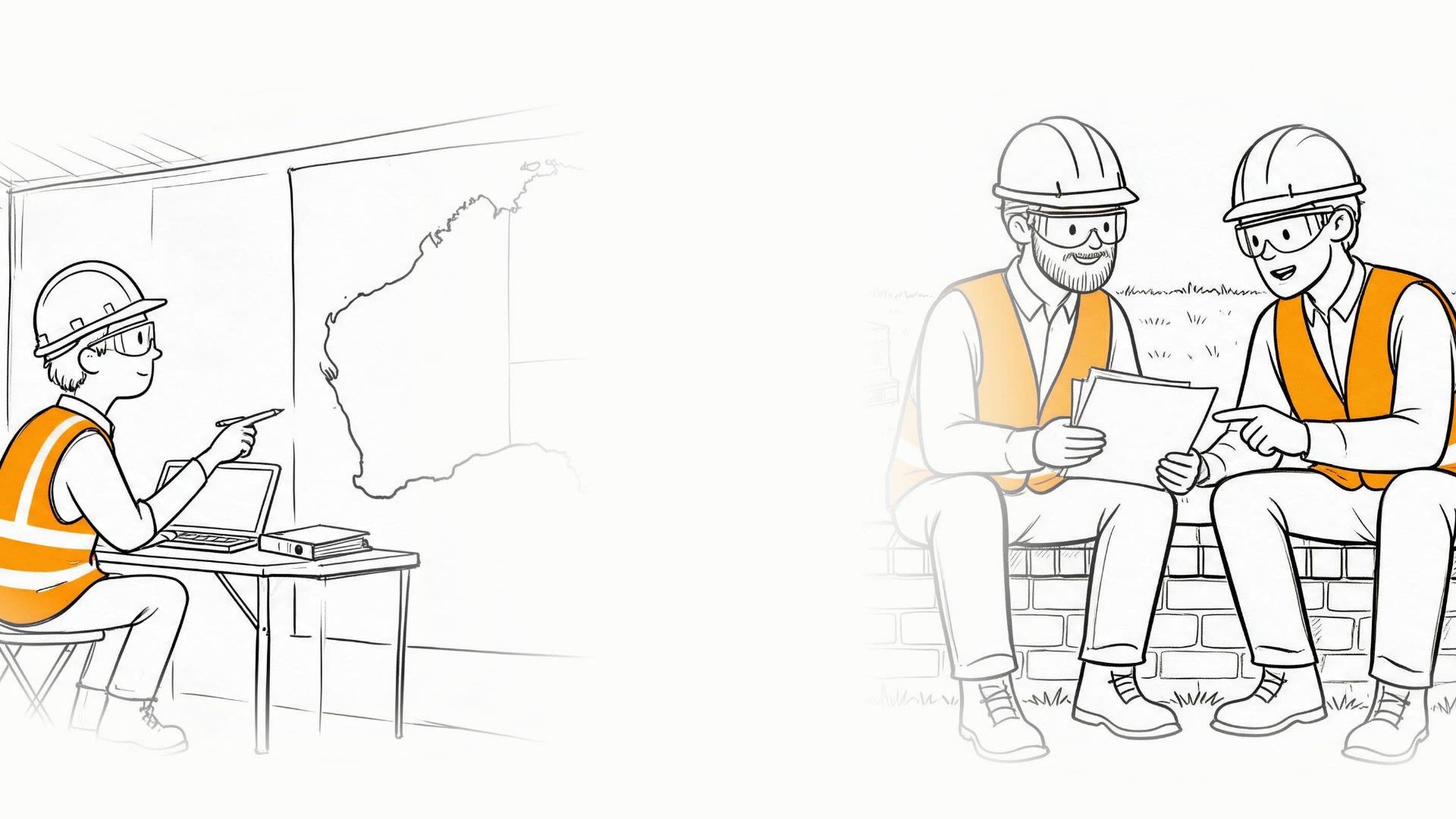
You need a Safe Work Method Statement (SWMS) for painting work that is high risk construction work (HRCW). For painters, the categories that come up most are a risk of falling more than 2 metres, work likely to disturb asbestos (such as preparing asbestos cement roofs), moving powered mobile plant such as elevating work platforms (EWPs), and spraying in areas that may have a flammable atmosphere.
A repaint of interior walls from a step ladder in a finished house is usually not high risk construction work. Repainting the eaves and gutters of a two-storey house, preparing an old fibro roof or abrasive blasting a steel structure is a different story. This guide sorts painting tasks into the categories, then covers what the SWMS has to say and where lead paint, silica and spray work fit.
For the general test, see do I need a SWMS?. For the full list, see high risk construction work: the 18 categories.
Which high risk construction work categories matter for painting?
The model Work Health and Safety (WHS) Regulations list 18 categories of high risk construction work in regulation 291. New South Wales, Queensland, Western Australia, South Australia and Tasmania use the same number and the same list. The Northern Territory and the ACT also use 291 with one change each, and Victoria has its own list (see Victoria and other states below). Painting is construction work when it is carried out in connection with the construction, alteration, renovation, repair, maintenance or refurbishment of a structure (regulation 289 of the model WHS Regulations). Testing, maintenance or repair work of a minor nature is excluded (regulation 289(3)(d) in the model and most states; the ACT numbers it differently). The categories painters hit most are construction work that:
- involves a risk of a person falling more than 2 metres
- involves, or is likely to involve, the disturbance of asbestos
- is carried out in an area at a workplace in which there is any movement of powered mobile plant
- is carried out in an area that may have a contaminated or flammable atmosphere
- is carried out on or near energised electrical installations or services
- is carried out on, in or adjacent to a road, railway, shipping lane or other traffic corridor that is in use by traffic other than pedestrians
- is carried out in an area in which there are artificial extremes of temperature.
One SWMS can cover several categories, as long as it covers all of the high risk construction work in the task.
Common painting jobs and the categories they often trigger
This is a guide, not a ruling. Whether a category applies depends on the building, the height, the age and condition of the existing coatings and what else is happening around you.
| Painting task | Often triggers | Note |
|---|---|---|
| Exterior painting of two-storey houses, eaves, fascias and gutters | Falls over 2 m | Ladder work at height needs careful thought; scaffold or an EWP is often the better control. |
| Painting from a boom or scissor lift | Falls over 2 m; powered mobile plant | Exclusion zones under and around the platform belong in the method. |
| Painting at height on commercial or industrial structures | Falls over 2 m; powered mobile plant | Rescue arrangements for harness work belong in the SWMS. |
| Preparing and painting asbestos cement roofs or walls | Likely disturbance of asbestos; falls over 2 m; fragile roof | Pressure cleaning and dry sanding of asbestos are restricted (see below). |
| Surface preparation on older buildings | Possibly asbestos | Lead paint is not an HRCW category, but it needs its own controls. |
| Spray painting in enclosed or poorly ventilated areas | Contaminated or flammable atmosphere | Ignition sources and ventilation are part of the controls. |
| Abrasive blasting | Often powered mobile plant, falls, contaminated atmosphere | Blasting media and the coating being removed both matter. |
| Line marking or painting beside a live road | Traffic corridor in use | Traffic management sits beside the SWMS. |
| Interior repaints in finished buildings at low height | Often none | A builder can still ask for a SWMS as a site rule. |
Two things the table does not change. A builder or principal contractor can ask for a SWMS for work that is not high risk construction work. And work outside the categories still has to be managed safely.
What must a painting SWMS cover?
Regulation 299 of the model WHS Regulations (299 in every state and territory except Victoria) says a SWMS must:
- identify the work that is high risk construction work
- state the hazards relating to that work and the risks to health and safety associated with those hazards
- describe the measures to be implemented to control the risks
- describe how the control measures are to be implemented, monitored and reviewed.
It must take into account the circumstances at the workplace and, on a construction project, the principal contractor's WHS management plan. It must be readily accessible and understandable to the people who use it.
For painting, that usually means the SWMS sets out:
- the height access method for this job (scaffold, mobile scaffold, EWP, trestles or ladders), why it was chosen and who checks it before use
- for EWPs, the operator's licence or competency, the ground conditions and the exclusion zone
- the coatings, solvents and thinners being used, with the safety data sheet controls, ventilation and ignition source control for spraying
- the respiratory protective equipment (RPE) for the task, named specifically
- how surface preparation dust is controlled, for example wet methods or on-tool extraction with an H-class vacuum
- what happens if asbestos or lead paint is suspected: stop, test or identify, and only resume under the right controls
- protection for occupants and the public, such as barricades and overspray control.
Workplace Health and Safety Queensland (WHSQ) says a phrase such as "use appropriate PPE" (personal protective equipment) does not detail the control measures. WorkSafe Victoria says listing many control options does not properly describe the measures being implemented. Both point the same way: name the control you will actually use.
Asbestos roofs, lead paint and abrasive blasting
These three come up often for painters and each has rules outside the SWMS.
Asbestos cement roofs and walls. Work that involves or is likely to involve disturbing asbestos is high risk construction work. Separately, regulation 446 of the WHS Regulations (the same number in every state and territory except Victoria) says a business must not use high-pressure water spray or compressed air on asbestos or asbestos-containing material (ACM), and must not use power tools, brooms or other implements that release airborne asbestos unless their use is controlled. See asbestos removal SWMS and licences.
Lead paint. Lead paint is not one of the high risk construction work categories, but removing it is regulated. The WHS Regulations list, as a lead process in regulation 392, using a power tool (including abrasive blasting and high pressure water jets) to remove a surface coated with paint containing more than 1% by dry weight of lead, and handling the resulting waste. Lead processes bring duties such as giving workers information about the health risks (regulation 395), and lead risk work brings health monitoring (regulations 405 and 406). Victoria has its own lead rules in the OHS Regulations 2017. If you are working on older paint, test first.
Abrasive blasting. Schedule 10, table 10.3 of the WHS Regulations (outside Victoria) restricts abrasive blasting with free silica (crystalline silicon dioxide) at a concentration greater than 1%, and lists other restricted substances for abrasive blasting and spray painting. Check the blasting media and the coating against that table.
What is in the Painting pack?
The Painting SWMS Trade Pack has 17 SWMS: one Painting Master SWMS and 16 task SWMS:
- Site Establishment & Setout
- Manual Handling
- Material Handling, Loading & Unloading
- Truck Operations & Deliveries
- Surface Preparation & Sanding
- Painting (General)
- Spray Painting
- Painting at Height
- Painting Asbestos Roofs
- Height Access Equipment
- EWP Operations
- Working at Heights - On Structure
- Hazardous Substances
- Working in Private Residences
- Abrasive Blasting
- Lead Paint Removal
The pack is $249.99 per state, in editable Word, and comes with a free pack of 16 safe operating procedures (SOPs), including airless spray equipment, portable sanders, the high pressure washer, EWPs and the abrasive blast pot. Each state edition references that state's Act and regulator.
If you are also asked for your safety system, the Painting All-In WHS Pack puts the same SWMS inside the policies, procedures, registers and forms for the business.
What still has to be tailored?
Before the SWMS goes to site, add:
- the site address, the builder or client and the date
- the heights and edges on this job and the access equipment you are using
- what is known about asbestos and lead in the existing surfaces, and any test results
- the products being applied and their safety data sheet controls
- the operators' licences and competencies for EWPs and spray or blast equipment
- who supervises, and how the controls will be checked
- the crew's sign-on, after you have talked it through with them.
See what to do after you download your SWMS pack.
Victoria and other states
Victoria lists 19 types of high risk construction work under its own Occupational Health and Safety (OHS) Regulations 2017, made under the OHS Act 2004, and has its own rules for asbestos and lead. Use WorkSafe Victoria's guidance for work there. The other states and territories have adopted the model WHS Regulations in their own laws, with two differences worth knowing. In the Northern Territory, the falls category for residential construction work (Class 1 houses, and Class 10 buildings such as garages, carports and sheds attached or next to them) applies where a person could fall more than 3 metres; the 2 metre threshold applies to other construction work. In the ACT, section 291 adds a 19th category: processing crystalline silica material using a power tool or another mechanical method. That can catch grinding or sanding concrete, render or masonry surfaces with a power tool before painting. See SWMS requirements by state.
Common questions
Do painters need a SWMS?
Painters need a Safe Work Method Statement (SWMS) for painting work that is high risk construction work, such as work with a risk of falling more than 2 metres, work likely to disturb asbestos, or work where powered mobile plant such as an elevating work platform is moving. Low interior work is often outside the categories, but many builders ask for a SWMS anyway.
Is painting an asbestos roof high risk construction work?
Preparing or painting an asbestos cement roof is likely to disturb asbestos, which is a high risk construction work category, and roof work often adds a fall risk. The WHS Regulations also ban high-pressure water spray and compressed air on asbestos (regulation 446), so pressure cleaning is not an option.
Is lead paint removal high risk construction work?
Lead paint is not one of the 18 high risk construction work categories, but removing paint containing more than 1% lead with power tools or abrasive blasting is a lead process under the WHS Regulations (regulation 392), with its own duties. The job may also be high risk construction work for other reasons, such as height.
Does spray painting need a SWMS?
Spray painting needs a SWMS when it is high risk construction work, for example when it is done at height or in an area that may have a flammable atmosphere. The SWMS should cover ventilation, ignition sources and respiratory protection.
Is the list different in Victoria or other states?
Victoria uses its own Occupational Health and Safety (OHS) Regulations 2017 and lists 19 types of high risk construction work. The categories are similar but worded separately, so check WorkSafe Victoria's list for work in Victoria. Two other places differ from the model list: in the Northern Territory the falls category for houses and their garages and sheds starts at more than 3 metres, and the ACT adds processing crystalline silica material with a power tool or other mechanical method as a 19th category.
Sources: Model WHS Regulations (Safe Work Australia), regulations 289, 291, 299, 392, 395, 405, 406 and 446 and schedule 10, table 10.3; the WHS Regulations of NSW, Queensland, WA, SA, Tasmania, the ACT (sections 291 and 418A) and the NT (regulation 291); Victoria's OHS Regulations 2017; WorkSafe Victoria; Workplace Health and Safety Queensland.
Start from a proper SWMS, not a blank page
State-specific, editable templates written for your state. Download instantly, then make it yours for the job and the site.
This guide is general information, not legal or safety advice, and does not guarantee compliance. Laws and site conditions vary, so always check your state regulator and have documents reviewed by a competent person.