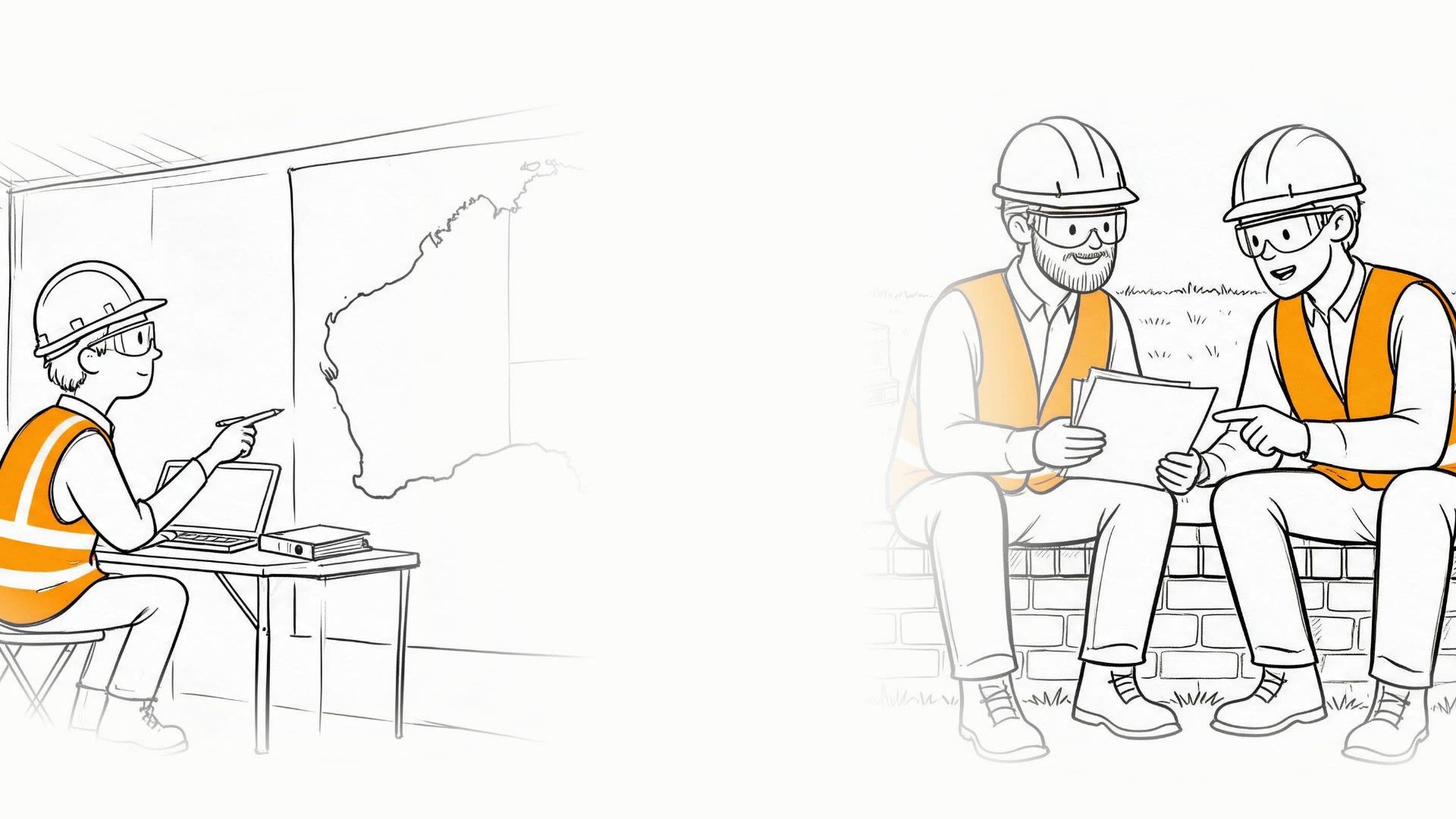
A Take 5 is a short personal safety check a worker does just before starting a task: stop, look at the job and the area, identify the hazards, make sure the controls are in place, and only then start. It takes a few minutes, is usually recorded on a pocket card or app, and supports the Safe Work Method Statement (SWMS) or job safety analysis (JSA) rather than replacing them.
The name comes from the idea of taking five minutes, or five steps, before you start. It is used widely on Australian construction, mining and maintenance sites, often as a site rule. This guide covers what it is, when to use one, how it fits with a SWMS and a JSA, and how to stop it becoming a tick-box exercise.
What is a Take 5?
A Take 5 is a pre-task risk check, done by the person about to do the work. It is not a formal risk assessment of the whole job. It is the last check that the plan still fits the conditions in front of you right now.
There is no official Take 5 form. The WHS Act and Regulations don't use the term Take 5, and businesses word their cards differently. What sits behind it is the risk management process that Safe Work Australia describes for every business: identify hazards, assess risks, control risks and review control measures. A Take 5 is that process done quickly, at the point of work, by the worker.
The five steps
Card wording varies, but most follow a pattern like this:
- Stop and think. Before you touch anything, think the task through from start to finish. Do you know how to do it? Do you have what you need?
- Look and identify. Look at the actual work area. What has changed since the SWMS or JSA was written? Weather, other trades, plant, ground, access, the people around you.
- Assess. Which of those hazards could hurt you or someone else on this task, today?
- Control. For each one, is the control in place now? Not in the ute, not planned for later. If not, put it in place.
- Proceed or stop. If it is safe, start. If something is not right and you cannot fix it, stop and talk to your supervisor.
Many cards also include prompts: tools and equipment checked, permits in place, isolations done, personal protective equipment (PPE) on, people nearby protected, fit for work.
When should you do a Take 5?
Your site or employer will usually set this. Common triggers are:
- before starting a new task
- when conditions change: weather, the crew, the equipment, other work nearby, or a new hazard
- when coming back to a task after a break where things may have changed
- when something does not feel right.
A real example: Queensland Hydro's published Workplace Health and Safety Management Plan says workers should do a Take 5 before starting a task where there is increased potential for harm, and that where work conditions (personnel, weather, tooling, new hazards, chemicals, work processes) change, each worker completes a Take 5 even if they did one at the start of the job. It also says that if unmanaged risk is identified, the worker discusses it with their supervisor and reviews the existing SWMS or safe operating procedures (SOPs), and that a JSA is completed where no SOP or SWMS exists for the activity.
Avoid setting fixed frequencies on the card that do not match the work. The trigger should be the task and the conditions.
Take 5, JSA or SWMS?
| Take 5 | JSA | SWMS | |
|---|---|---|---|
| What it is | A personal pre-task check | A step-by-step risk assessment for one task | A required document for high risk construction work |
| Who does it | The worker about to do the task | The crew and supervisor | The business doing the high risk work, with its workers |
| When | Just before the task, and when conditions change | Before the task, reviewed when it changes | Before high risk construction work starts |
| Required by law? | No | No (WorkSafe Victoria: not required under legislation) | Yes, for high risk construction work |
| Length | A card or one screen | Usually one to a few pages | As long as the high risk work needs |
The key point: a Take 5 never replaces a SWMS. If the work is high risk construction work (HRCW), the WHS Regulations require a SWMS before it starts, and if the work is not being done in line with the SWMS, it must stop. A Take 5 is one of the ways a worker notices that the job has drifted from the SWMS.
See SWMS vs JSA vs SOP, what is a JSA? and do I need a SWMS?.
What makes a Take 5 work?
- It is done at the work area. Filling in the card in the lunch room before walking to the job misses the point.
- A "no" is welcome. The card exists to find the thing that is not right. If every card for a month says "all good", either the site is perfect or nobody is looking.
- Supervisors act on it. When a worker stops a job because of a Take 5, the response should be to fix the problem, not to ask why the job stopped.
- It links to the SWMS or JSA. If a Take 5 finds a hazard the SWMS or JSA does not cover, the right next step is to update the SWMS or do a JSA, not just to write it on the card.
- It is short. A Take 5 with three pages of tick boxes becomes a form people sign without reading.
Common mistakes
- Treating it as the risk assessment. A Take 5 checks a plan. It does not replace one.
- Pre-filled cards. A card completed in advance, or copied from yesterday, records nothing.
- Collecting cards nobody reads. If Take 5 cards are only collected and filed, the findings never get fixed. Someone should look at them for trends and repeat problems.
- Using it to shift responsibility. The business still has to plan the work, provide the controls and supervise. A worker's Take 5 does not transfer that duty.
Keeping records
There is no legal retention period for Take 5 cards, because there is no legal requirement for them. Sites set their own rules. Queensland Hydro's plan, for example, says completed Take 5s should be kept on site for two months, and that a Take 5 linked to a task where an incident occurred should be attached to the incident report. If your site uses cards, decide how long they are kept and who reviews them.
When a Take 5 is not enough
If the task needs more thought than a pocket card can hold, step up to a JSA: break the task into steps, set out the hazards and controls for each, and talk it through with the crew. Our JSA templates cover 408 tasks across the trades, in editable Word, with the steps, hazards, risk ratings and controls drafted for you to adapt to the site. See JSA template: what a good one includes.
If the task is high risk construction work, it needs a SWMS. See our SWMS Trade Packs.
Common questions
What is a Take 5 in safety?
A Take 5 is a short pre-task safety check done by the worker just before starting a task. The worker stops, looks at the task and the area, identifies hazards, confirms the controls are in place, and only then starts. It supports the SWMS or JSA for the job; it does not replace them.
Is a Take 5 a legal requirement?
The WHS Act and Regulations don't use the term Take 5. Many sites and employers require one as a site rule. The legal duty is to manage risks, and for high risk construction work a Safe Work Method Statement (SWMS) is required.
What are the 5 steps of a Take 5?
Wording varies, but most cards follow: stop and think; look and identify hazards; assess the risk; control the hazards; then proceed only if it is safe, or stop and talk to your supervisor.
What is the difference between a Take 5 and a JSA?
A Take 5 is a quick personal check done by one worker at the point of work. A job safety analysis (JSA) is a written, step-by-step risk assessment for a task, usually prepared by the crew and supervisor before work starts.
Can a Take 5 replace a SWMS?
No. If the work is high risk construction work, a Safe Work Method Statement (SWMS) must be prepared before it starts. A Take 5 can help a worker check the job still matches the SWMS on the day.
Sources: Safe Work Australia, Identify, assess and control hazards, Queensland Hydro, Workplace Health and Safety Management Plan (HS-PLN-0001), section 6.1.4 Take 5, WorkSafe Victoria, Safe work method statements (SWMS) and Work Health and Safety Regulation 2011 (Qld), sections 299 and 300.
Start from a proper SWMS, not a blank page
State-specific, editable templates written for your state. Download instantly, then make it yours for the job and the site.
This guide is general information, not legal or safety advice, and does not guarantee compliance. Laws and site conditions vary, so always check your state regulator and have documents reviewed by a competent person.